Trademark Ownership After Company Dissolution – Hong Kong vs Singapore

Safeguarding Intellectual Property: Trademark Ownership After Company Dissolution in Hong Kong vs. Singapore

When a business winds down or is struck off the registry, intellectual property (IP) is frequently overlooked. While physical inventory, bank accounts, and real estate are carefully liquidated or distributed, valuable intangible assets like registered trademarks are often forgotten. Under the corporate laws of both Hong Kong and Singapore, once a company is formally dissolved, any remaining undistributed assets—including trademark rights—may become unclaimed property, legally termed bona vacantia, and automatically vest in the government. This means your brand, logo, and the goodwill attached to them could suddenly belong to the state, frozen from commercial use.


LEGAL FRAMEWORK & OWNERSHIP TRANSITION

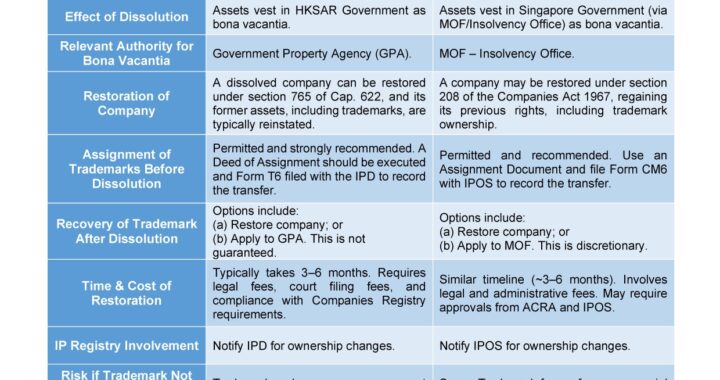
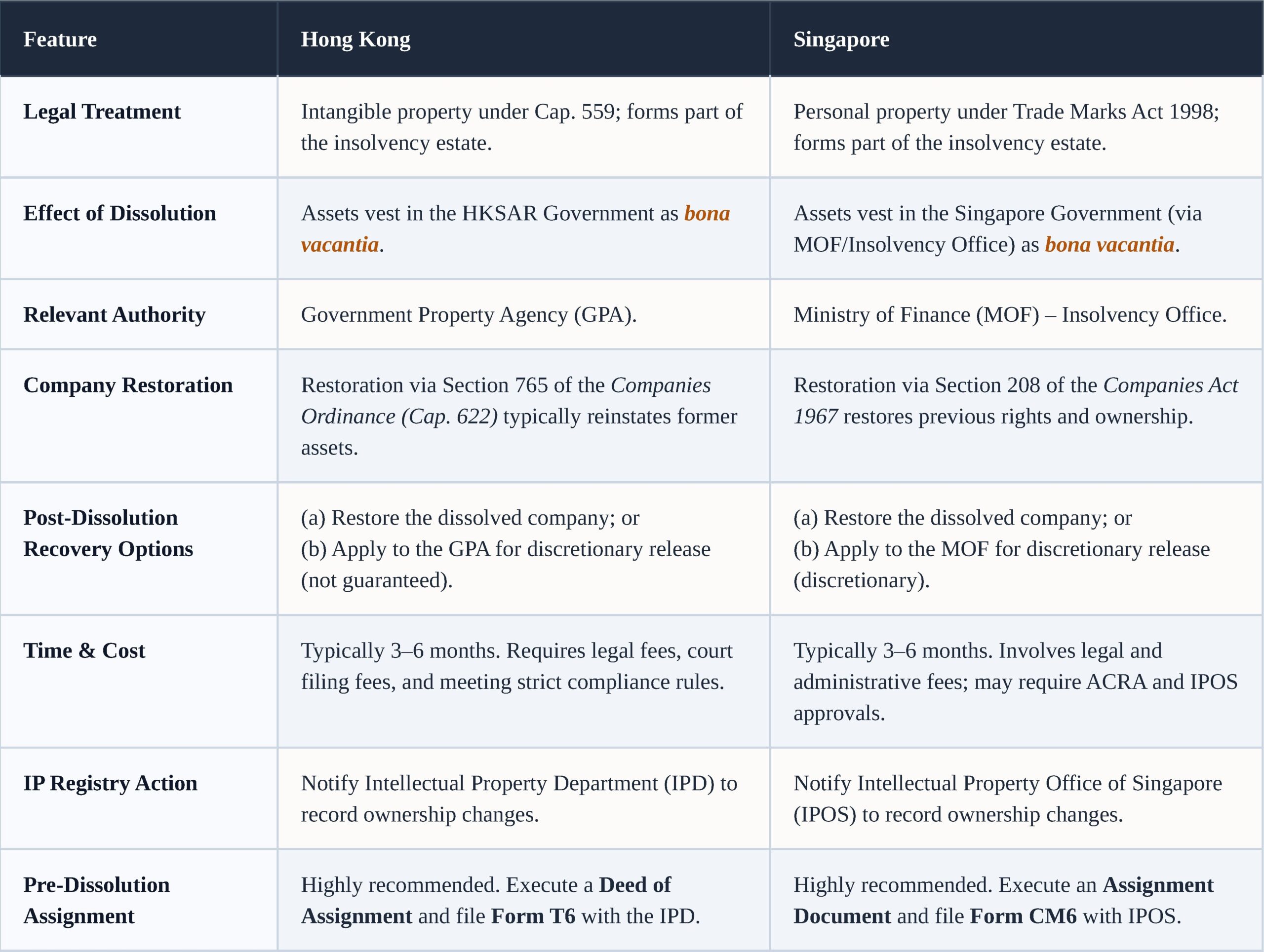
In both jurisdictions, intellectual property is strictly classified as property that forms part of an insolvency or dissolution estate. In Hong Kong, registered trademarks are recognized as intangible property under the Trade Marks Ordinance (Cap. 559). Upon dissolution, these assets vest in the HKSAR Government as bona vacantia, managed by the Government Property Agency (GPA). Similarly, Singapore treats trademarks as personal property under the Trade Marks Act 1998. Upon a company's dissolution, these assets vest in the Singapore Government as bona vacantia, with the Ministry of Finance (MOF) – Insolvency Office acting as the relevant authority. Under either government's ownership, the trademark becomes commercialized deadwood—frozen and legally unusable by the original founders, affiliates, or third parties unless recovered through formal, complex channels.


COMPARATIVE ANALYSIS: HONG KONG VS. SINGAPORE

While both regions follow a similar common-law approach to unclaimed property, the exact pathways to recovery, statutory provisions, and administrative bodies differ. The table below outlines these crucial operational and legal distinctions:
 

STRATEGIC RECOMMENDATIONS

Relying on post-dissolution recovery is a high-risk strategy. Government bodies exercise strict, discretionary oversight over bona vacantia claims. The process is lengthy, expensive, and legally uncertain. To avoid losing your hard-earned brand equity, Accolade IP recommends taking proactive measures before any dissolution procedures begin:


Essential Checklist Before Dissolution

Conduct a Comprehensive IP Audit: Identify all registered trademarks, patents, designs, and pending applications owned by the company slated for dissolution. Execute Trademark Assignments: Draft and legally execute assignment documents transferring ownership to a parent company, sister company, individual founder, or a trust.

Record the Transfer: Promptly file the appropriate recorded forms with the respective IP registries—Form T6 with the Hong Kong IPD, or Form CM6 with IPOS in Singapore.
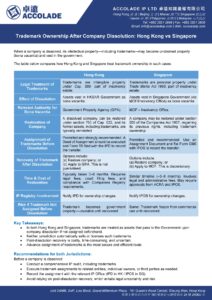
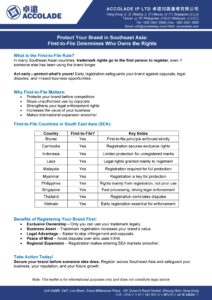
Protect Your Brand in Southeast Asia: First-to-File Determines Who Owns the Rights

Protect Your Brand in Southeast Asia: First-to-File Determines Who Owns the Rights

What is the First-to-File Rule?

In many Southeast Asian countries, trademark rights go to the first person to register, even if someone else has been using the brand longer.

Act early—protect what’s yours!

Early registration safeguards your brand against copycats, legal disputes, and missed business opportunities.

Why First-to-File Matters:

  • Protects your brand before competitors
  • Stops unauthorized use by copycats
  • Strengthens your legal enforcement rights
  • Increases the value of your business
  • Makes international expansion smoother
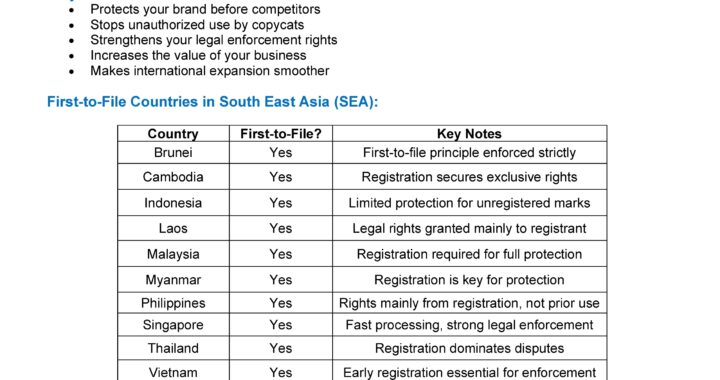
First-to-File Countries in South East Asia (SEA): Country First-to-File? Key Notes
Brunei Yes First-to-file principle enforced strictly
Cambodia Yes Registration secures exclusive rights
Indonesia Yes Limited protection for unregistered marks
Laos Yes Legal rights granted mainly to registrant
Malaysia Yes Registration required for full protection
Myanmar Yes Registration is key for protection
Philippines Yes Rights mainly from registration, not prior use
Singapore Yes Fast processing, strong legal enforcement
Thailand Yes Registration dominates disputes
Vietnam Yes Early registration essential for enforcement

 Benefits of Registering Your Brand First:

  • Exclusive Ownership – Only you can use your trademark legally.
  • Business Asset – Trademark registration increases your brand’s value.
  • Legal Advantage – Easier to stop infringement and copycats.
  • Peace of Mind – Avoid disputes over who used it first.
  • Regional Expansion – Registration makes entering SEA markets smoother.


Take Action Today! Secure your brand before someone else does.

Register across Southeast Asia and safeguard your business, your reputation, and your future growth.

Note: This leaflet is for informational purposes only and does not constitute legal advice

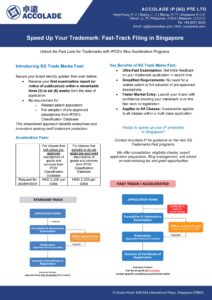
Speed Up Your Trademark: Fast-Track Filing in Singapore

Speed Up Your Trademark: Fast-Track Filing in Singapore

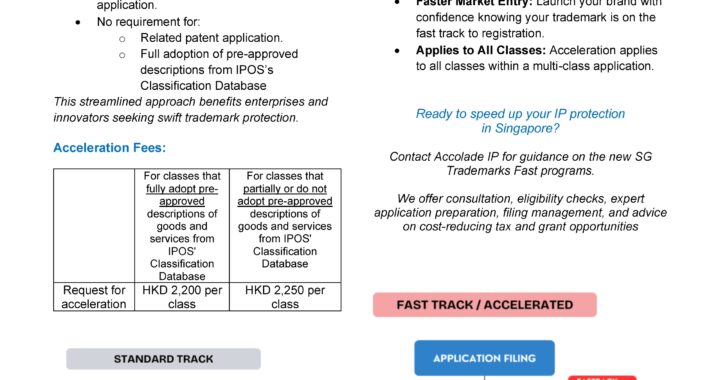
Unlock the Fast Lane for Trademarks with IPOS's New Acceleration Programs

Introducing SG Trade Marks Fast:

Secure your brand identity quicker than ever before:
• Receive your first examination report (or notice of publication) within a remarkable three (3) to six (6) weeks from the date of application.
• No requirement for:
o Related patent application.
o Full adoption of pre-approved descriptions from IPOS’s Classification Database

This streamlined approach benefits enterprises and innovators seeking swift trademark protection.

table

Acceleration Fees:

For classes that fully adopt preapproved descriptions of goods and services from IPOS' Classification Database For classes that partially or do not adopt pre-approved descriptions of goods and services from IPOS' Classification Database
Request for acceleration HKD 2,200 per class HKD 2,250 per class

Key Benefits of SG Trade Marks Fast:

• Ultra-Fast Examination: Get initial feedback on your trademark application in record time.
• Simplified Requirements: No need for a related patent or full adoption of pre-approved descriptions.
• Faster Market Entry: Launch your brand with confidence knowing your trademark is on the fast track to registration.
• Applies to All Classes: Acceleration applies to all classes within a multi-class application

Ready to speed up your IP protection in Singapore?

Contact Accolade IP for guidance on the new SG Trademarks Fast programs.
We offer consultation, eligibility checks, expert application preparation, filing management, and advice on cost-reducing tax and grant opportunities

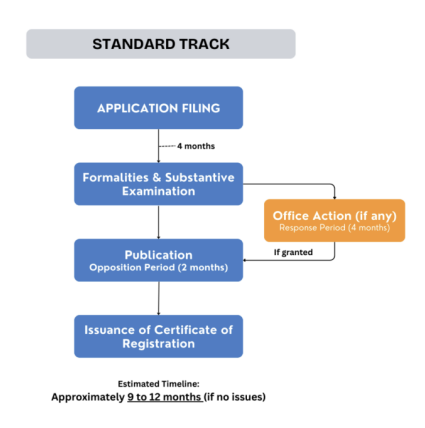
Trademark Standard Track"
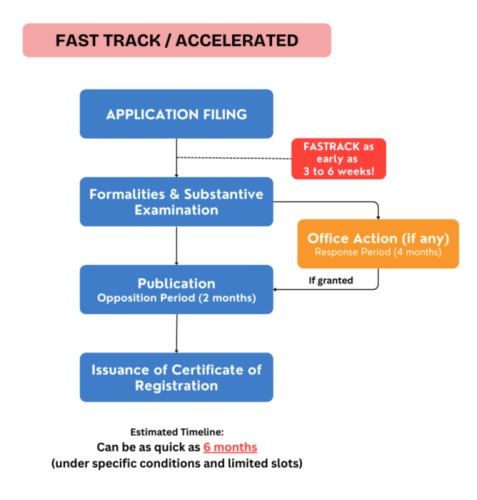
Trademark Fast Track"

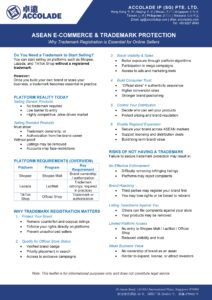
ASEAN E-COMMERCE & TRADEMARK PROTECTION

Do You Need a Trademark to Start Selling?

You can start selling on platforms such as Shopee, Lazada, and TikTok Shop without a registered trademark.
However:
Once you build your own brand or scale your business, a trademark becomes essential in practice.

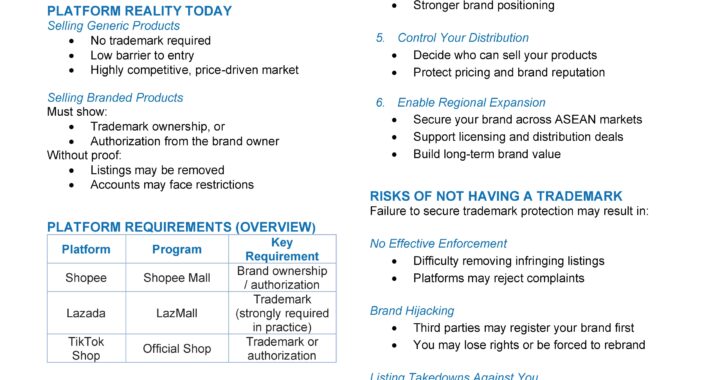
PLATFORM REALITY TODAY

Selling Generic Products
  • No trademark required
  • Low barrier to entry
  • Highly competitive, price-driven market
Selling Branded Products
Must show:
  • Trademark ownership, or
  • Authorization from the brand owner
Without proof:
  • Listings may be removed
  • Accounts may face restrictions
PLATFORM REQUIREMENTS (OVERVIEW)
Platform Program Key Requirement
Shopee Shopee Mall Brand ownership / authorization
Lazada LazMall Trademark (strongly required in practice)
TikTok Shop Official Shop Trademark or authorization

WHY TRADEMARK REGISTRATION MATTERS

  • Protect Your Brand
    • Remove counterfeit and copycat listings
    • Enforce your rights directly on platforms
    • Prevent unauthorized sellers
  • Qualify for Official Store Status
    • Verified brand badge
    • Priority placement in search
    • Access to exclusive campaigns
  • Boost Visibility & Sales
    • Better exposure through platform algorithms
    • Participation in mega campaigns
    • Access to ads and marketing tools
  • Build Consumer Trust
    • “Official store” = authenticity assurance
    • Higher conversion rates
    • Stronger brand positioning
  • Control Your Distribution
    • Decide who can sell your products
    • Protect pricing and brand reputation
  • Enable Regional Expansion
    • Secure your brand across ASEAN markets
    • Support licensing and distribution deals
    • Build long-term brand value

RISKS OF NOT HAVING A TRADEMARK

Failure to secure trademark protection may result in: No Effective Enforcement
  • Difficulty removing infringing listings
  • Platforms may reject complaints
Brand Hijacking
  • Third parties may register your brand first
  • You may lose rights or be forced to rebrand
Listing Takedowns Against You
  • Others can file complaints against your store
  • Your products may be removed
Limited Platform Access
  • No entry to Shopee Mall / LazMall / Official Shop
  • Reduced visibility and trust
Weak Business Value
  • No ownership of brand as an asset
  • Harder to expand, license, or attract investors

Note: This leaflet is for informational purposes only and does not constitute legal advice