leaflet-download

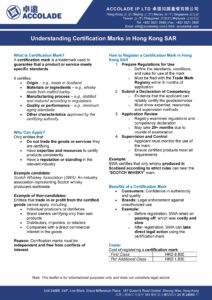
Guide to Understanding Certification Marks in Hong Kong SAR

Guide to Understanding Certification Marks in Hong Kong SAR

What is a Certification Mark?

A certification mark is a specialized category of trademark used to guarantee that a product or service meets specific defined standards.

It certifies key attributes including:

  • Origin: e.g., made in Scotland.
  • Materials or Ingredients: e.g., whisky made exclusively from malted barley.
  • Manufacturing Process: e.g., distilled and matured strictly according to legal regulations.
  • Quality or Performance: e.g., meeting minimum aging and maturation standards.
  • Other Characteristics: Any other quality standards approved by the certifying authority.

Who Can Apply?

Only qualified entities that meet strict regulatory requirements can apply for a certification mark:

  • Do not trade in or supply the goods or services they are certifying.
  • Possess adequate expertise and resources to certify products consistently.
  • Have established reputation or standing in the relevant industry.

Example Candidate: Scotch Whisky Association (SWA) — An industry association representing Scotch whisky producers worldwide.

Non-candidates (Ineligible Entities): Entities that trade in or profit directly from the certified goods cannot apply, including individual producers/distilleries, brand owners certifying only their own products, distributors, importers, retailers, or companies with a direct commercial interest.

Core Principle: Certification marks must remain strictly independent and free from any conflicts of interest.

How to Register a Certification Mark in Hong Kong SAR

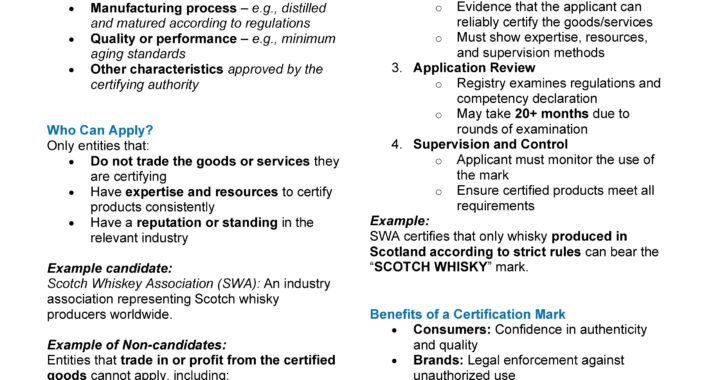
  1. Prepare Regulations for Use: Define detailed standards, conditions, and rules for using the mark. These regulations must be filed with the Trade Mark Registry within 9 months of application.
  2. Submit a Declaration of Competency: Provide verifiable evidence that the applicant can reliably certify the goods/services, showing technical expertise, resources, and oversight mechanisms.
  3. Application Review: The Registry examines both the regulations and competency declaration. This process may take 20+ months due to legal examination requirements.
  4. Supervision and Control: The applicant must actively monitor the mark's use to ensure all certified products strictly comply with rules (e.g., SWA ensures only whisky distilled in Scotland under strict laws bears the 'SCOTCH WHISKY' mark).

Benefits of a Certification Mark

  • For Consumers: Gives immediate confidence in product authenticity, geographic origin, and quality.
  • For Brand Owners & Associations: Provides robust legal grounds to take direct enforcement action against unauthorized or counterfeit use.

Case Example: Before registration, SWA had to rely on 'passing off' common law actions, which were costly, complex, and slow. After registration, SWA can enforce rights directly using the registered certification mark.

Official Registration Costs

Item Official Fee (HKD)
First Class HKD 8,800
Per Additional Class HKD 1,800
Note: This article is for informational purposes only and does not constitute legal advice.
 

Trademark Ownership After Company Dissolution – Hong Kong vs Singapore

Safeguarding Intellectual Property: Trademark Ownership After Company Dissolution in Hong Kong vs. Singapore

When a business winds down or is struck off the registry, intellectual property (IP) is frequently overlooked. While physical inventory, bank accounts, and real estate are carefully liquidated or distributed, valuable intangible assets like registered trademarks are often forgotten. Under the corporate laws of both Hong Kong and Singapore, once a company is formally dissolved, any remaining undistributed assets—including trademark rights—may become unclaimed property, legally termed bona vacantia, and automatically vest in the government. This means your brand, logo, and the goodwill attached to them could suddenly belong to the state, frozen from commercial use.


LEGAL FRAMEWORK & OWNERSHIP TRANSITION

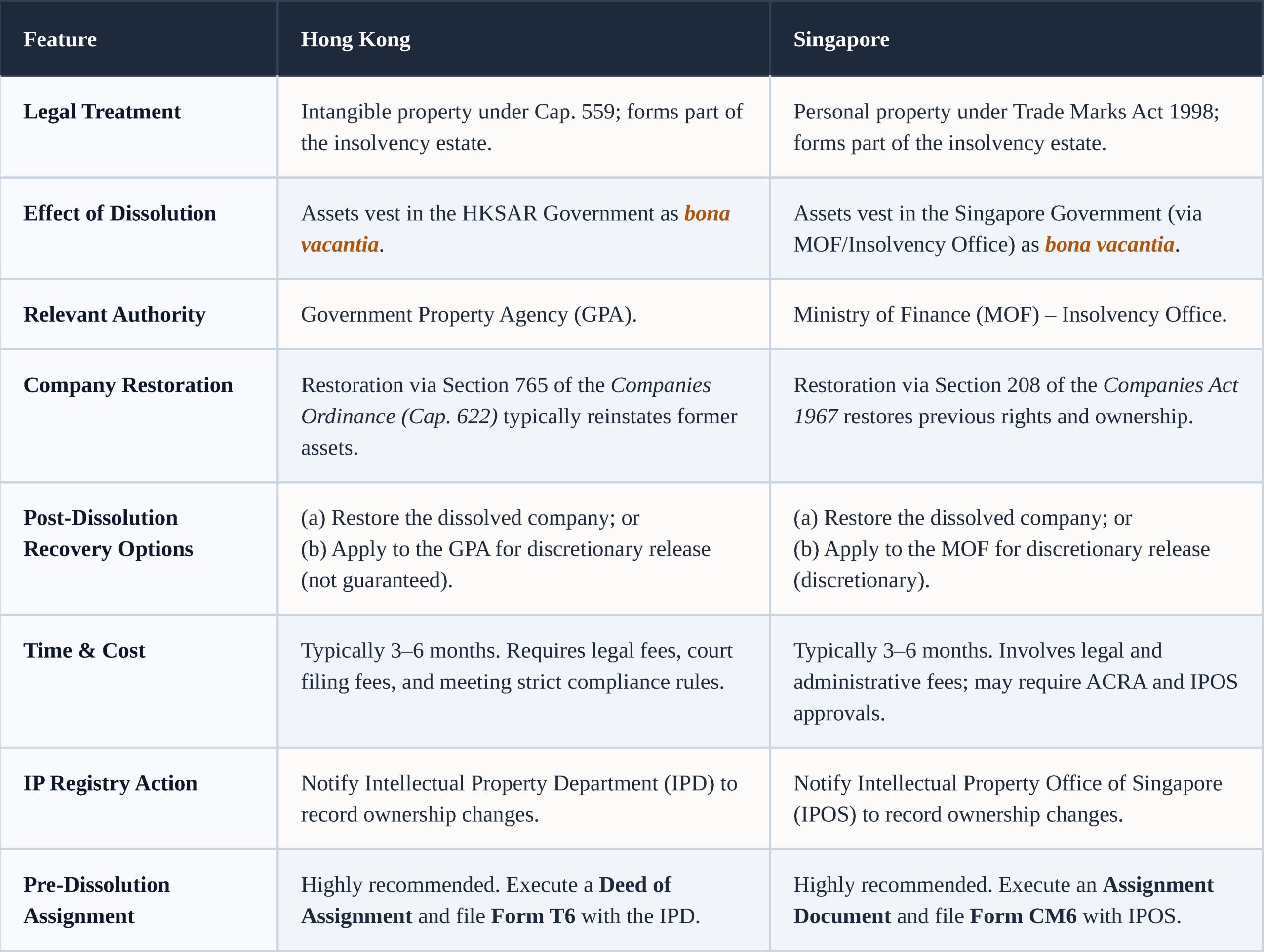
In both jurisdictions, intellectual property is strictly classified as property that forms part of an insolvency or dissolution estate. In Hong Kong, registered trademarks are recognized as intangible property under the Trade Marks Ordinance (Cap. 559). Upon dissolution, these assets vest in the HKSAR Government as bona vacantia, managed by the Government Property Agency (GPA). Similarly, Singapore treats trademarks as personal property under the Trade Marks Act 1998. Upon a company's dissolution, these assets vest in the Singapore Government as bona vacantia, with the Ministry of Finance (MOF) – Insolvency Office acting as the relevant authority. Under either government's ownership, the trademark becomes commercialized deadwood—frozen and legally unusable by the original founders, affiliates, or third parties unless recovered through formal, complex channels.


COMPARATIVE ANALYSIS: HONG KONG VS. SINGAPORE

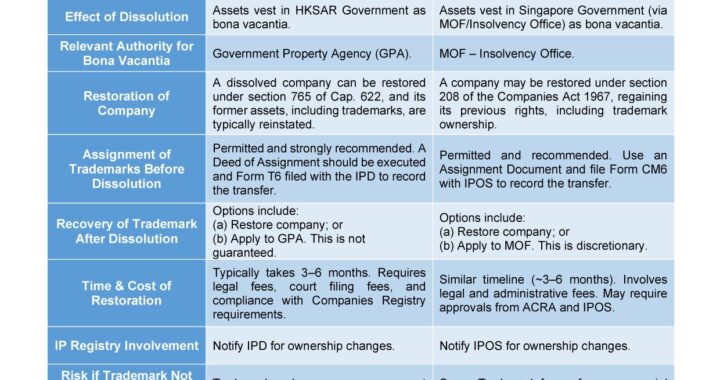
While both regions follow a similar common-law approach to unclaimed property, the exact pathways to recovery, statutory provisions, and administrative bodies differ. The table below outlines these crucial operational and legal distinctions:


STRATEGIC RECOMMENDATIONS

Relying on post-dissolution recovery is a high-risk strategy. Government bodies exercise strict, discretionary oversight over bona vacantia claims. The process is lengthy, expensive, and legally uncertain. To avoid losing your hard-earned brand equity, Accolade IP recommends taking proactive measures before any dissolution procedures begin:


Essential Checklist Before Dissolution

Conduct a Comprehensive IP Audit: Identify all registered trademarks, patents, designs, and pending applications owned by the company slated for dissolution. Execute Trademark Assignments: Draft and legally execute assignment documents transferring ownership to a parent company, sister company, individual founder, or a trust.

Record the Transfer: Promptly file the appropriate recorded forms with the respective IP registries—Form T6 with the Hong Kong IPD, or Form CM6 with IPOS in Singapore.