[AIPHK] HK Trademark Opposition

Hong Kong Trademark Opposition

Hong Kong Trademark Opposition

Q: Who may file an Opposition to a trademark application?

Section 44 of the Trade Marks Ordinance (Cap. 559) provides that “any” person may give notice to the Registrar of opposition to the registration of a trade mark as an Opponent. The only qualification to this broad statement is that the notice must be given in writing within the prescribed period, in the prescribed manner, and shall contain a statement of the grounds of opposition.

Q: Is it compulsory to defend my application when being opposed by others?

As a trademark Applicant, it is compulsory to defend your application by filing a counter-statement to avoid abandonment. You can also provide evidence in the form of a statutory declaration or affidavit to support your argument. NOTE: The foregoing estimates are approximate only. For
opposition cases, settlement of the matter can occur relatively early in the proceedings or at any point thereafter (in case both parties reach a deal).

Q: How long is the process time and What is the procedure?

The main steps to be taken by Applicant and Opponent are set out below:-

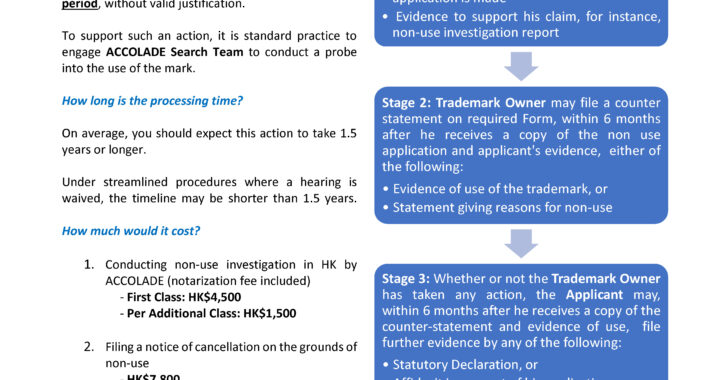
HK Trademark Opposition Procedure Flow Chart

Quotation (HKD)

Filing a formal opposition as Opponent: $5,800

Filing a counterstatement as Applicant: $8,800

Filing evidence:
Basic fee: $8,800
Notarization: $1,500
Evidence review:
$80 per page

Filing extension of
time (once): $500

Hearing
(non-mandatory):
$60,000 or more

ASEAN E-COMMERCE & TRADEMARK PROTECTION

Do You Need a Trademark to Start Selling?

You can start selling on platforms such as Shopee, Lazada, and TikTok Shop without a registered trademark.
However:
Once you build your own brand or scale your business, a trademark becomes essential in practice.

PLATFORM REALITY TODAY

Selling Generic Products
  • No trademark required
  • Low barrier to entry
  • Highly competitive, price-driven market
Selling Branded Products
Must show:
  • Trademark ownership, or
  • Authorization from the brand owner
Without proof:
  • Listings may be removed
  • Accounts may face restrictions
PLATFORM REQUIREMENTS (OVERVIEW)
Platform Program Key Requirement
Shopee Shopee Mall Brand ownership / authorization
Lazada LazMall Trademark (strongly required in practice)
TikTok Shop Official Shop Trademark or authorization

WHY TRADEMARK REGISTRATION MATTERS

  • Protect Your Brand
    • Remove counterfeit and copycat listings
    • Enforce your rights directly on platforms
    • Prevent unauthorized sellers
  • Qualify for Official Store Status
    • Verified brand badge
    • Priority placement in search
    • Access to exclusive campaigns
  • Boost Visibility & Sales
    • Better exposure through platform algorithms
    • Participation in mega campaigns
    • Access to ads and marketing tools
  • Build Consumer Trust
    • “Official store” = authenticity assurance
    • Higher conversion rates
    • Stronger brand positioning
  • Control Your Distribution
    • Decide who can sell your products
    • Protect pricing and brand reputation
  • Enable Regional Expansion
    • Secure your brand across ASEAN markets
    • Support licensing and distribution deals
    • Build long-term brand value

RISKS OF NOT HAVING A TRADEMARK

Failure to secure trademark protection may result in: No Effective Enforcement
  • Difficulty removing infringing listings
  • Platforms may reject complaints
Brand Hijacking
  • Third parties may register your brand first
  • You may lose rights or be forced to rebrand
Listing Takedowns Against You
  • Others can file complaints against your store
  • Your products may be removed
Limited Platform Access
  • No entry to Shopee Mall / LazMall / Official Shop
  • Reduced visibility and trust
Weak Business Value
  • No ownership of brand as an asset
  • Harder to expand, license, or attract investors

Note: This leaflet is for informational purposes only and does not constitute legal advice

Intellectual Property Enforcement Action Hong Kong

Intellectual Property Dispute Enforcement in Hong Kong

Intellectual Property Dispute Enforcement in Hong Kong

A Practical Guide for Brand Owners & Businesses

Protecting your brand in Hong Kong is both practical and effective, with clear legal pathways available to address infringement and enforce your rights.

What Rights Are Protected?

Hong Kong protects both registered and unregistered rights, including:

  • Trade marks
  • Copyright
  • Registered designs
  • Patents

Unregistered rights may also be enforced through passing-off actions

Your Enforcement Options

1.     Cease & Desist (First Step)

A fast, cost-effective way to stop infringement.
Often results in a binding undertaking without litigation.

2.     Civil Action

Handled by the
High Court of Hong Kong

  • Formal legal proceedings against infringers
  • Typical timeline: 15–30 months

Remedies include:

  • Injunctions
  • Damages / profits recovery
  • Delivery up of infringing goods

3.     Urgent Relief

Available in serious cases:

  • Injunctions
  • Search & seizure orders
  • Asset freezing

4.     Criminal Enforcement

Through the Hong Kong Customs and Excise Department

  • Investigates infringement
  • Seizes counterfeit goods
  • Prosecutes offenders

Customs & Border Action

While no formal recordal system exists, rights holders can file complaints with Customs to:

  • Detain suspicious shipments
  • Seize counterfeit goods
  • Initiate prosecution

Key Takeaways

  • Act early to maximise protection
  • Strong evidence is critical
  • Settlement is often encouraged
  • A combined strategy (civil + criminal + customs) is most effective

How We Can Help

We provide end-to-end support, including:

  • Enforcement strategy
  • Cease & desist actions
  • Litigation and dispute management
  • Customs and anti-counterfeiting coordination

Which IP Enforcement Option Is Right for You?

Option Cost Speed Binding Best Use
Cease & Desist Low Fast No Early disputes
Mediation Low–Medium Fast No Settlement
Arbitration Medium–High Medium Yes Contractual disputes
Registry Actions Low Medium Yes TM validity
Customs Low Fast Yes Counterfeits
Litigation High Slow Yes Complex disputes

Notice on Updating the “Domestic Recipient Address” for China Trademark

Notice on Updating the “Domestic Recipient Address” for China Trademark

Updates of China National Intellectual Property Administration (CNIPA) Trade Mark Document Service Rules, and Official Service Rule Explanation:
When the CNIPA issues trade mark–related legal documents, the only official address used for service is the “Domestic Recipient Address” recorded in the Trade Mark Office system.

If this address is unable to receive mail properly (for example, returned mail or failed delivery), the Trade Mark Office may, in accordance with the law, effect service by public announcement. Upon completion of the announcement period, such service is deemed legally effective, and the relevant procedures will continue.

Failure to respond within the statutory time limit may result in:

  • A non-use cancellation being upheld
  • The trade mark being declared invalid
  • Loss of trade mark rights, which is usually difficult to remedy

Such risks are not uncommon in practice and are particularly significant for Hong Kong, Macau, Taiwan, and overseas rights holders. Missing a deadline can mean losing years of brand investment with little chance of recovery.

Value-Added Service Arrangement

To help you mitigate these risks, if you entrust us to update the Domestic Recipient Address, this will be handled as a limited-time value-added service with no additional service charge for the time being.

We will:

  • Act as a stable domestic recipient for official correspondence
  • Monitor and promptly relay official documents issued by CNIPA
  • Provide timely response and strategic recommendations
  • Assist in the centralized management of your China trade mark matters

Disclaimer: The information presented herein does not and is not intended to constitute legal advice. All information provided is for general informational purposes only.